
The Neuroscience of Posture: The Way You Sit Affects Your Brain Chemistry
From brain fog to low confidence to jaw definition, the complete breakdown of what your posture is doing to your body and brain right now


the self improvement conversation has the same list of advice recycled constantly.
work out. sleep eight hours. clean diet. read. meditate. cold showers. morning routine.
all genuinely good and all worth doing.
but there’s one thing that almost nobody talks about seriously despite the fact that it’s affecting you right now as you read this sentence, that it’s been affecting you for years, and that fixing it costs absolutely nothing and takes no extra time in your day.
posture.
and before you click away thinking this is going to be some basic “sit up straight” article, let me tell you why the way you hold your body is actively changing your brain chemistry in real time.
because it is.
and the current state of most people’s posture is a slow motion disaster that they won’t understand the full cost of until the damage is already done.
think about how people sit and stand today.
hunched over a laptop for eight hours. neck craned down over a phone for another three or four. sitting in a chair designed more for the office aesthetic than for spinal health.
driving with the shoulders rolled forward. watching tv from a position that would make a physiotherapist cry.
the forward head posture that comes from phone use, called tech neck, means the head is sitting an average of two to three inches forward from where it should be.
for every inch of forward translation, the effective weight of the head on the cervical spine increases by roughly ten pounds.
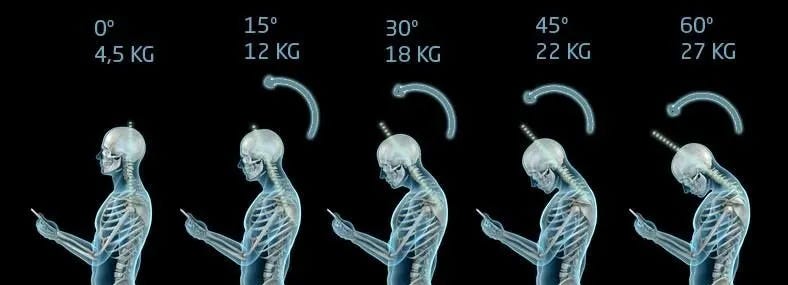
your head weighs about twelve pounds in neutral position.
in a forward posture, it can be exerting the load equivalent of sixty pounds on your neck and spine.
think about that for a second.
you’re walking around with the structural equivalent of a five year old sitting on the back of your head.
but the physical damage is only part of it.
the list of what prolonged poor posture is doing to you is longer and more serious than most people know.
forward head posture increases unnecessary gamma wave brain activity at rest, which disrupts psychological relaxation and creates a state of chronic low-grade hyperarousal and stress.
slouching restricts the diaphragm. reduced diaphragm function means shallower breathing.
shallower breathing means less oxygen to the brain. less oxygen means brain fog, fatigue, and reduced cognitive function.
the jugular veins and cerebrospinal fluid flow are restricted by poor cervical posture. your brain’s ability to drain toxins and receive proper blood flow is compromised by how you hold your head.
poor posture is consistently associated with negative thought patterns, lower self-reported confidence, and higher rates of anxiety and depression.
and that’s just the tip of the iceberg for the internal
the external is a whole other iceberg.
posture affects your face.
forward head posture forces the jaw backward, creating the appearance of a recessed chin and softened jawline definition.
the tongue drops from the roof of the mouth where it provides natural structural support for the upper jaw.
soft tissue under the chin begins to sag. the temporomandibular joint gets stressed, leading to chronic jaw pain, headaches, and bite misalignment.
the way you hold your body is literally shaping your face over time.
and the most common misconception that people have when they hear all this is this:
“okay so i just need to sit up straight right?”
so they pull their shoulders back for five minutes, feel mildly virtuous, and then within twenty minutes they’re back in the exact same position they were in before.
because that’s not how this works.
the solution to a posture problem that has been building for years is not willpower applied intermittently.
it’s a rewiring of the system that is currently keeping you in the position you’re in.
and that’s what this post is actually about.
sitting up straight as a lazer beam as i type this.
it’s extra on the conscious mind today given the topic.
the single thing that can change your entire life.
let’s get into it.
WHY SLOUCHING IS NEUROLOGICALLY INGRAINED AND HARD TO CHANGE
"the mind and body are not separate. what affects one affects the other."
i grew up playing video games.
hours a day, especially as a teenager. sitting close to the screen, neck forward, shoulders hunched, completely lost in whatever game was running.
i never thought about my posture once.
and why would i? nothing hurt. nothing seemed wrong. i was just sitting.
but my nervous system was learning.
every hour in that position was training my postural muscles to treat that position as neutral.
the deep stabilizing muscles of the spine were learning to accept a forward head, rounded shoulder position as the baseline.
and the muscles that would hold you in proper alignment, the deep cervical flexors, the lower trapezius, the rhomboids, were going chronically underactivated and progressively weakening.
neurologically, this is a motor learning problem as much as it is a muscle problem.
your brain has a representation of where your body is in space called a proprioceptive map.
this map is constantly updating based on where your body spends most of its time.
if you spend most of your time in a slouched position, your proprioceptive map recalibrates to treat that position as upright.
which means when you actually sit up straight, it feels wrong.
uncomfortable and forced. like you’re overcorrecting.
that is the most fucked part about all of this
technically you’re actually in a neutral position when you sit up straight.
but your nervous system has been trained to experience neutral as effortful.