
How To Build A Second Brain
Why biological memory is the wrong tool for serious intellectual work and how to build the external system that thinks with you

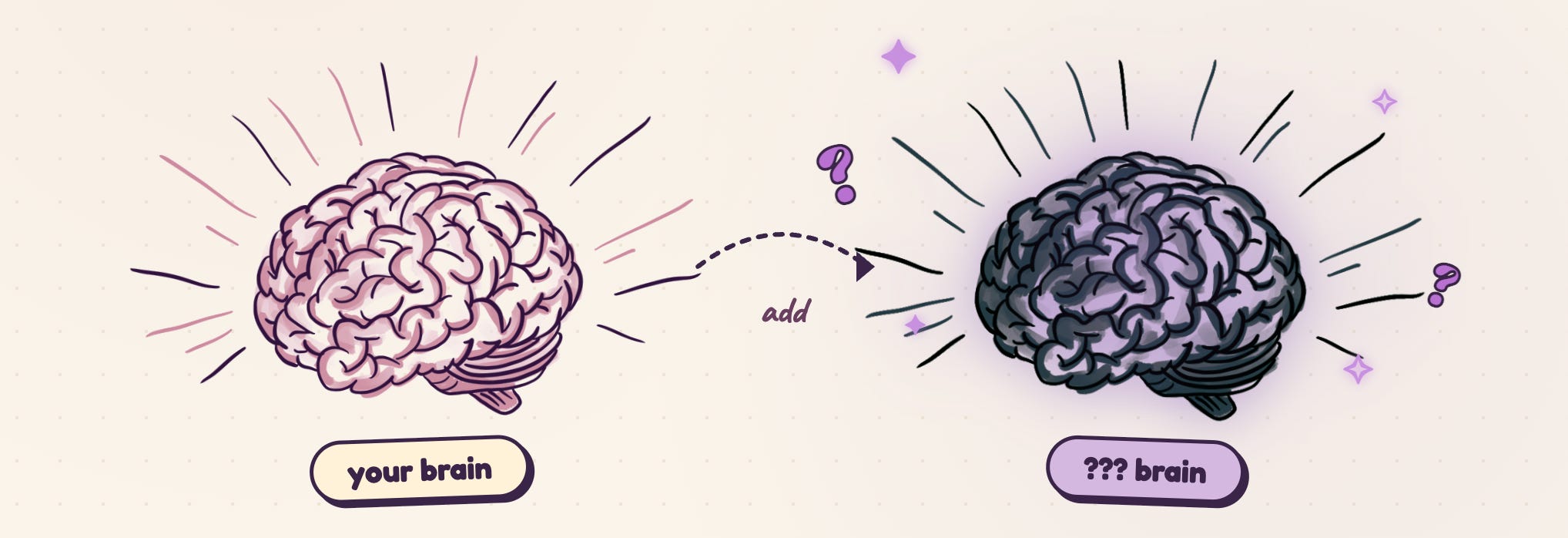
the smartest people alive don’t trust their memory for serious intellectual work.
they trust systems.
darwin kept meticulous notebooks. every observation, every developing theory, every question he hadn’t answered yet.
the notebooks wasn’t something to aid his thinking. instead of treating the notebook as supplementary he treated it as if it were part of his thinking.
da vinci carried a small notebook everywhere he went. thousands of pages of observations, sketches, questions, cross-domain connections that wouldn’t find their application until years later.
newton’s papers. einstein’s journals. feynman’s notebooks where he worked through problems visually rather than purely abstractly.
the pattern across the most productive minds in history is not exceptional memory.
it’s exceptional systems.
and here’s what modern research on cognition confirms.
human memory is associative, emotional, contextual, and unreliable for exact retrieval.
it was never optimized for storing complex information across long time horizons. it was optimized for survival and real-time pattern recognition. for navigating social dynamics.
not for building a knowledge architecture that compounds over a lifetime.
which means the school system’s entire premise is built on the wrong foundation.
i have always hated the conflation of grades with intelligence.
there are so many types of intelligence first of all. but even setting that aside, school literally runs on testing and memorization. sit in a room, read a thing, close the book, prove you can reproduce it. that’s the metric.
there’s a famous analogy about this. a school decides to give a standardized test to all animals. the class includes a monkey, a fish, an elephant, a bird, and a dog.
the test is: climb this tree.
the monkey excels. obviously.
the fish fails. the elephant fails. the bird fails. the dog fails.
and the conclusion is they’re less intelligent.
which is insane. each of those animals has extraordinary intelligence perfectly adapted to their environment. the fish doesn’t need to climb a tree. it navigates underwater. its intelligence lives in a completely different domain.
we ran a version of this test on humans for decades.
the ones who could memorize and reproduce information on command got rewarded. everyone else was quietly told they weren’t smart.
the smartest operators figured out the truth.
intelligence is the quality of the systems surrounding your thinking.
not your storage capacity.
and in this post i’m going to walk you through exactly how to build one.
the capture-organise-distill-express pipeline. the PARA framework. the zettelkasten method. atomic notes. knowledge graphs. and the exact minimalist setup that actually works in practice.
this is the full system.
whiteboard in front of me. filled with frameworks and arrows. capture pointing to organize.
organize pointing to distill.
distill pointing to express.
PARA underneath it, projects, areas, resources, archives, each box labelled and connected.
notebook open next to me with each framework dissected like a patient on a table.
black coffee with raw honey. ambient music low through the speaker.
neurological anchors doing their job.
let’s build this properly.
YOUR BRAIN IS FOR THINKING. NOT STORAGE.
"the palest ink is better than the best memory." — chinese proverb
human memory is associative. emotional. contextual. and genuinely unreliable for the kind of work that matters.
it is not optimized for exact retrieval and long-term organization.
it is optimized for survival. real-time pattern recognition. navigating social dynamics. learning motor skills. emotional processing.
storing your research notes reliably? not what it was built for.
the mistake most people make is trying to remember everything.
the approach that actually works is different.
capture everything potentially useful and structure it intelligently.
compress it down to principles so you can retrieve it when needed and than recombine it into original insight.
this is what researchers call external cognition.
a second brain is essentially this: a system that thinks with you.