


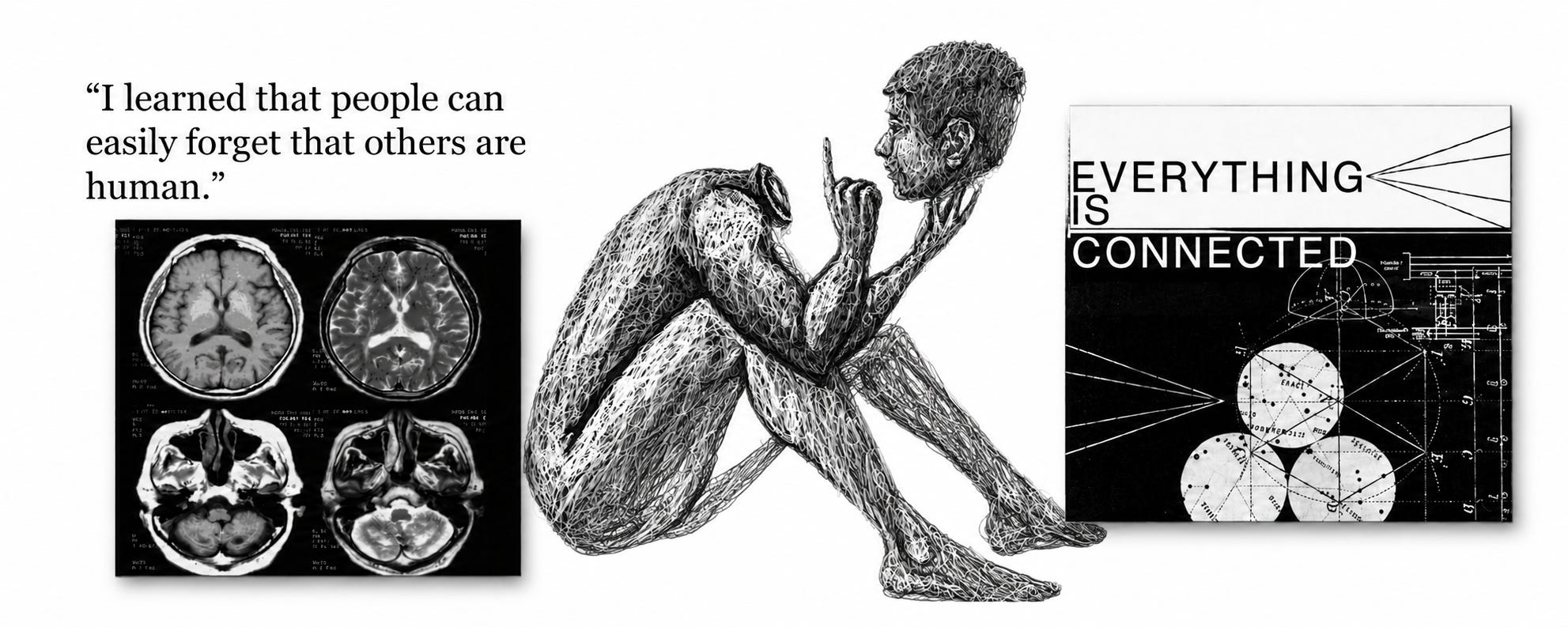
in this vast, dark universe the earth came to be from the elements of a dying star.
and ever since consciousness showed up on this little planet, we’ve spent every single waking moment trying to be a little less alone.
language. we invented an entire system of symbolic noises just so what’s inside one head could be transferred, imperfectly, into another.
music. every culture that ever existed developed music independently. all of us, across every corner of the planet started humming and drumming and singing without talking to each other first.
storytelling. before the written word, we were already sitting around fires making up myths. gods. heroes. monsters. shared imagination as the first bridge.
religion. the biggest attempt of all. an entire framework claiming there’s a being out there who already knows all of it. who you are, what you meant, the part you couldn’t bring yourself to say out loud, and what happens after all this is said and done.
we want our consciousness to relate on some level. that’s what every single one of these things is.
i also have a deep desire to be understood to the point where i can let myself be vulnerable and let someone in.
but it’s also my greatest fear.
simone de beauvoir had the opposite problem. or maybe just the opposite answer.
“i am fully aware and in full possession of myself. i have no desire to be understood, admired, pitied, or even known.”
she wrote that in her diary at 19. called it the highest form of existence.
to have that level of awareness and understanding at that age is crazy.
a 19 year old looking at the thing most adults spend their entire lives chasing and saying no thanks.
in her memoir she describes a younger version of herself.
curious about everything and interested in everything while also refusing every limitation anyone tried to put on her.
she called that freedom.
and i would agree with her.
the hunger to be known, validated, admired, understood at all costs is a symptom of not knowing yourself.
if you don’t know who you are, you need someone else to tell you.
if you do know who you are, you don’t.
most people live in the first camp their entire lives.
every job they take, every relationship they stay in, every post they make, is a quiet audition.
see me. tell me i’m real.
the second you’re in full possession of yourself, your life stops depending on someone else’s attention.
you stop waiting for the room to confirm you.
you just are. and life just is.
life simply exists as a raw, neutral reality without inherent labels.
people like this are strangely present when you meet them. there’s no part of them scanning your face for approval. they’re there with you instead of auditioning in front of you.
and the best part of achieving this state?
if you don’t need to be understood, nobody can control you.
that need is the hook.
that’s the handle. everyone who’s ever manipulated you did it through that exact handle…
it’s late as i write this. one of those quiet nights where everything feels suspended.
no black coffee this time. caffeine at this hour would keep me up until the sun rises.
just some soft ambient music that’ll keep me writing until i drift to sleep.
my window is slightly open with cold air breezing in. feels like drinking ice cold water while chewing gum.
the sky is clear tonight. it’s one of those nights where you can see the stars for once.
i keep looking up at them like they might say something back.
let’s get into this.
BE CAREFUL WHAT YOU EAT WHEN YOUR STARVING
“All the unhappiness of men arises from one single fact, that they cannot stay quietly in their own chamber.” — Blaise Pascal
you know how anything tastes good when your hungry?
when i’m hungry i eat a pb and j sandwich like it’s the juiciest steak i’ve ever ate at a 5 star michelin restaurant.
i savor every bite of the sandwich even though it’s a completely regular meal.
sometimes i even eat things that are bad for me, just because i’m so hungry.
and i don’t even notice the food is bad. all i’m worried about is satisfying my hunger.
the same applies with our desire to be understood.
there’s actual neuroscience under this.
when your brain is starved of something it needs (connection, validation, understanding), the prefrontal cortex, the part that handles judgment, slows things down and goes partially offline.
the filter that asks “is this actually what you want?” is no longer there.
the limbic system takes the wheel.
the amygdala and reward circuitry drives urgent, attachment-seeking behavior to restore a sense of safety.
at this point, survival overrides discrimination.
that’s why hungry people make bad food choices. and why lonely people make bad partner choices.
the same parts of the brain are at play here.
people stay in toxic relationships because someone finally “understands” them.
people buy from businesses that “understand” their problems.
people become loyal to friends who make them feel seen.
this desire is primal to our core.
and for that exact reason it can be dangerous.
just because someone recognizes something private about you doesn’t mean they’re safe to trust completely.
maybe they named an insecurity you’ve never managed to explain or they had a similar childhood.
or maybe even they listened for an hour without reaching for their phone.
that can be the beginning of something real but it can also make you overlook what happens afterward.
recognition is a reason to pay attention but it is not enough evidence to trust someone with the parts of you that can be hurt.
an ad can describe your frustration perfectly without the product solving a single thing. a friend can recognize your loneliness exactly and still repeatedly fail to show up for you.
the point is that someone can understand your pain and still treat you badly.
recognition, reliability, and care are three separate things.
you need all three.
cults know this. abusers know this. good salesmen know this. every single person in the business of extracting something from another human being has studied this exact craving.
understanding this hunger is about noticing when relief is making your decisions for you.
YOU WANT TO BE SEEN. BUT WHAT ARE YOU ACTUALLY SHOWING?
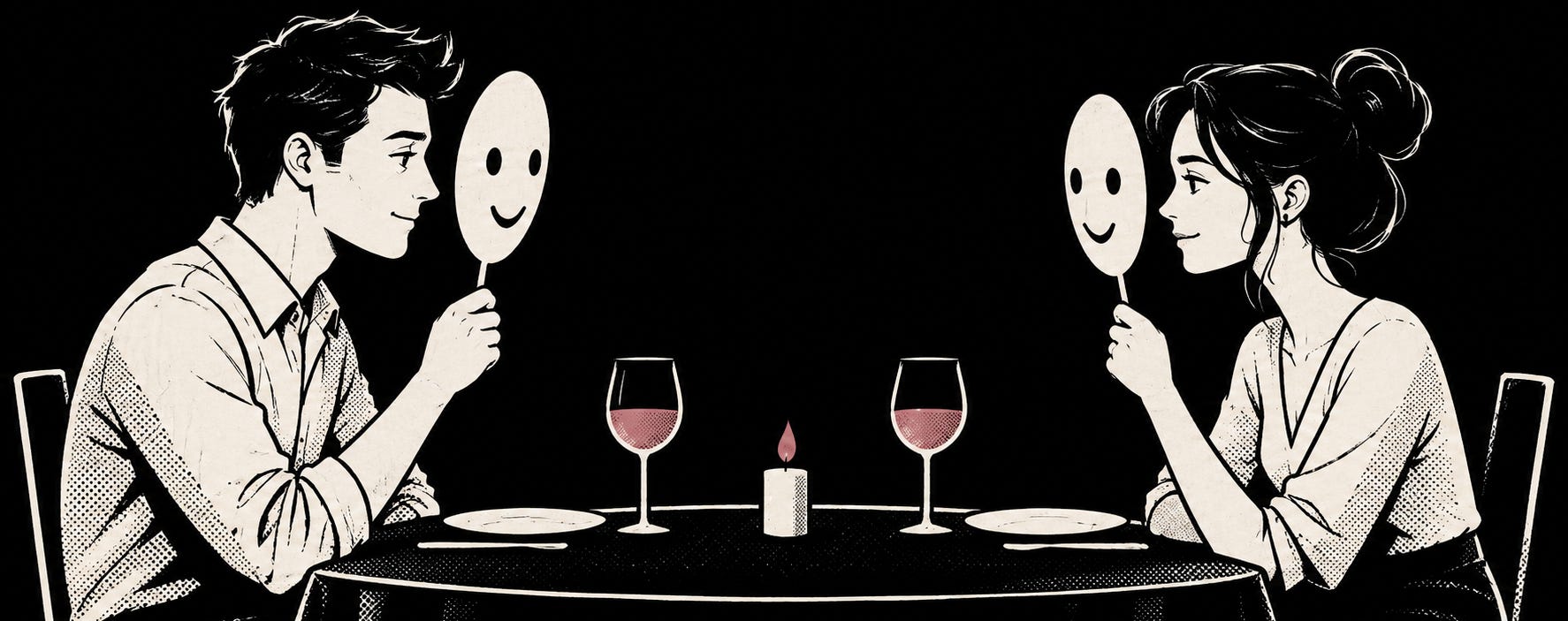
you want to be understood, but you don’t want to put yourself at risk of being seen.
we’ve all done it.
we joke when things are getting too real.
we say “i’m fine” when we’re anything but.
we tell stories of painful events as if they happened to someone else.
and we wonder why we wake up feeling unseen.
but think about how convenient that arrangement actually is.
you get to keep everything hidden and still feel disappointed that nobody found it.
you get to be the misunderstood protagonist of your own life without ever having to risk being understood.
“i want someone to understand me without having to say the things that would make that possible.”
interesting, isn’t it?
of course, being misunderstood hurts. but what about being truly understood and still rejected?
wouldn’t that hurt even more?
imagine someone seeing the parts of yourself you’ve spent years hiding. your insecurities, your fears, the things you’re ashamed to admit even to yourself.
and after understanding all of that, they decide they don’t want you.
that’s a completely different kind of pain.
that’s the risk we avoid by deflecting with humor, by telling surface-level stories, and by always saying “i’m fine.”
there was a study in 1998 that investigated what promotes intimacy in day-to-day interactions.
they found that sharing emotions was a much stronger predictor of feeling intimacy with someone than sharing facts.
see, we can tell someone what happened to us (the facts) without ever telling them what it meant to us (the emotions).
and most people do this their entire lives and then wonder why they don’t feel connected to others.
you can tell someone about a terrible experience you had growing up. explain exactly what happened, who was involved, and how it ended.
but telling them how that experience still affects the way you see yourself today? how it makes you afraid of getting close to people?
now you’re actually letting someone in.
one is sharing information. the other is making yourself vulnerable.
and most people spend their entire lives confusing the two.
but if you want others to truly understand you, you must first be willing to risk rejection.
there’s no way around it.
YOU WILL NEVER BE FULLY UNDERSTOOD
“Every man has some reminiscences which he would not tell to everyone, but only to his friends. He has others which he would not reveal even to his friends, but only to himself, and that in secret. But finally there are still others which a man is even afraid to tell himself.” — Fyodor Dostoevsky
but here’s the irony of it all.
even then. even if you show up with everything.
nobody will ever fully understand your complex, unique existence.
it’s simply impossible.
the only way that could happen is if someone grew up in the exact same conditions as you and had the exact same experiences.
but even then, with what we know about temperament and how biologically different we are at birth, it could still be different.
throughout your entire life, all your experiences have shaped this lens you view life through and all of us have a different lens.
some of us have the same shades. some of us have completely different shades.
we tend to gravitate toward people whose shades overlap with ours. that’s as close as it gets.
but i want you to understand this.
the depth of your existence is deeper than any ocean and more vast than the entire universe. there is so much about you that only the voice in your head will ever understand.
your consciousness. your awareness. your soul. your mind.
whatever you want to call it.
at the end of the day that is truly the only thing that can understand you.
now watch what happens when a person refuses to accept this.
as these feelings of being misunderstood continue to build up within our hearts, we grow resentful toward people.
“how could they not understand me after everything i’ve done for them?” we think, as we contemplate the people who betrayed us.
it feels as if we are stuck in a world of cold indifference. the more these feelings of resentment build up, the more we start to hate the world and the people who failed to understand us.
or at least that’s the way we like to see it.
ask yourself a different question.
are you asking to be understood, or are you asking to be agreed with?
sometimes someone understands your reasoning completely and still thinks you made the wrong decision.
they understand why you’re angry and still think you treated someone unfairly.
they understand how much your goal matters and still question your plan.
if every disagreement becomes “you don’t get me”, you’ve made understanding impossible to demonstrate without obedience.
and understanding without obedience is the only real kind.
someone can understand why you did something and still think you shouldn’t have done it.
that’s a hard thing to accept when what you really wanted was permission.
the opposite trap exists too.
someone saying “i understand” doesn’t automatically mean they listened.
show the difference through behavior.
can they explain your perspective back to you accurately? can they acknowledge what matters to you before arguing with it?
those are the markers. not the words.
the desire to be understood isn’t the problem on its own. the desire is ordinary.
the problem is where you locate the standard.
if the standard is they must perfectly understand me without me having to explain, that’s mind-reading, and it ends every relationship it enters.
if the standard is they must agree with me after they understand, that’s just obedience.
the desire became an obsession.
the obsession bred delusion.
the delusion created suffering nobody else can see.
and because we’re obsessed with being understood in one specific way, we invalidate every form of care people actually give us.
like the parent who cooks for you every day. who worries about your mental well-being but doesn’t know how to approach you.
like the friends who invite you out because they’ve noticed you were isolating yourself.
like the ex who checks up on you, hoping your situation has improved.
like the old classmate who calls and asks how you’ve been.
like the former crush who’s happy to know you’ve finally found your person.
like everyone else who checks up on you from time to time.
there might be more people doing this for you than you’ve been letting yourself see.
you just have to get out of your own head to notice.
and here’s what i want you to take away from this section.
you will never be fully understood and that’s fine.
one person doesn’t have to understand every part of you.
that was never the setup.
your parent might understand your exhaustion but have no idea what your creative work means to you.
one friend understands your humor. a different one understands your ambition.
somebody else knows what grief has done to you because they lived through something similar.
you can receive something real from each of these without demanding that any one of them hold the entire thing.
the expectation that one person (your partner, your best friend, your therapist, your mother) must contain the whole of you is a modern invention.
and it’s crushing every relationship it touches.
distribute the weight.
SHIFT TOWARD SELF-UNDERSTANDING
“Knowing others is wisdom; knowing yourself is enlightenment.” — Lao Tzu
you need to go on a deep journey of self discovery.
true freedom comes when you stop trying to translate your entire complex self to the outside world.
carl jung called this process individuation.
the lifelong work of becoming the whole person you actually are instead of the fragmented version you perform for other people.
he thought it was the actual meaning of a human life and that everything else was secondary.
the hungry hungry version of you wants someone else to hand you yourself.
a partner. a sibling. a friend group. an audience.
somebody who finally sees you and reflects you back so you can relax into being a real person.
that never works.
no external mirror has enough resolution to reflect back at you accurately.
the only container that can hold the full of you is you.
building self-respect and self-acceptance reduces the urgency of needing everyone else to get it right.
ask yourself this.
if nobody told you who you were, no family, no friends, no followers, no comment section.
would you still know?
most people couldn’t answer that. and that’s the whole problem.
solitude is where you find out.
and solitude isn’t just about being lonely and miserable.
no, it’s quite the opposite. when i say ‘solitude’ i’m talking about the sovereign kind.
anthony storr wrote an entire book called solitude arguing that the capacity to be alone is one of the actual markers of psychological maturity.
people who can’t be alone with themselves are perpetually running from the one person they can never leave.
the paradox nobody tells you.
the more you know yourself, the less you need other people to know you.
and the less you need it, the more real connection becomes possible, because you’re no longer using the other person as a mirror.
that doesn’t mean you stop needing people.
you will always need people. humans are social creatures.
needing people isn’t the problem. needing them to tell you who you are is.
here’s a small exercise you can actually use.
the next time you catch yourself thinking nobody understands me, run through these five questions.
what do i actually wish they understood?
what have i actually told them?
what response am i hoping for?
have i asked for that directly?
what does their response actually show me?
watch what happens.
half the time you’ll notice you never actually said the thing.
the other half you’ll notice you did say it but you were hoping they’d read between the lines and give you an exact pre-written response you had running in your head.
self-understanding is about becoming clear enough to tell someone what you actually need, and clear enough to see honestly how they respond when you do.
THE COLLECTIVE CONSCIOUSNESS
i thought i’d bring up this idea because i think it’s a beautiful way to look at how we connect to others.
jung believed that the human psyche was made up of layers, and that beneath the personal unconscious there was a deeper level he called the collective unconscious.
there’s one consciousness, and you’re one window into it.
there’s a reason why christianity talks about the body of christ, that the buddha talks about interbeing, a reason why hinduism talks about atman and brahman.
they’re all trying to describe the same thing.
carl jung called it the collective unconscious.
the idea is that underneath your individual conscious mind there’s another level, a collective level that all human beings share.
this collective unconscious contains archetypes and universal symbols, like the hero, shadow, trickster, great mother, wise old man, etc, that can be found in every culture.
jung thought these archetypes weren’t learned but instead inherited, hardwired into us as human beings.
this would explain why archetypes and universal symbols keep recurring in cultures that have no contact with one another.
the collective unconscious is like a vast psychic ocean that each individual psyche drinks from.
jung’s idea of the collective unconscious goes beyond what neuroscience can currently prove, but we do know that there are certain universal patterns that all human brains recognize. for example the way we recognize faces, or the way we all respond to music in similar ways.
jung just went one step further than that and said not only are there certain universal patterns hardwired into the human brain, but these patterns manifest themselves as certain universal symbols and archetypes in our dreams and creative works.
so while neuroscience currently can’t prove jung right, neither can it prove him wrong.
it may sound mystical, but think about it for a moment.
have you ever read a poem or piece of writing and felt like the writer was writing directly to you?
or heard a song and felt compelled to pull the car over to the side of the road because it expressed something in you so perfectly?
or come across a passage in a prayer book and thought, how did they know that about me?
in each of these examples the chances are you’re connecting with the writer or musician at the level of the collective unconscious.
they may live, or have lived, in a completely different time and space to you, but you’re both connecting at the deeper level, the level of the collective unconscious.
that’s why a passage in a book written by an author who’s been dead for 200 years can speak to you so powerfully, you’re both tapping into the same level, the level that lies beneath each of our individual consciousness’.
in the same way that a child in japan who’s never read the odyssey can have a dream about the hero, and a child in brazil who’s never read the odyssey can have the exact same dream.
you and the author/musician/prayer writer are tapping into the same source and expressing it through your individual conscious minds.
on one level you are all different.
on another level you’re all the same, just expressing it through different costumes.
and this brings me onto my final point.
you are connected to everyone else.
that hunger you feel to be seen and understood by another person?
it’s misguided, because in truth you are connected to everyone else. you’re just trying to connect at the wrong level, on the level of the individual personality.
if you can tap into that deeper level, the level jung called the collective unconscious, the level mystics of every tradition have tried to describe in their own unique ways, then you’ll realize something.
you’re not alone. you’ve never been alone.
and that hunger to be seen and understood?
it’ll quieten down a little once you realise that because you’ll remember that you were never alone in the first place.
MAKE PEOPLE FEEL SEEN
you know that feeling of desperately wanting to feel seen by another person?
you know that feeling because you’ve wanted that yourself.
so why not try and provide that for others? even a little?
once you understand charisma you realize the most magnetic people in the world have one distinctive ability.
they make people feel seen.
there’s a region in your brain called the fusiform face area.
it’s the part that’s activated when another person is paying attention to you.
and i’m not talking about the feigning attention. not paying attention the way we all do while scrolling our phones and nodding along.
no.
when another person is actually present with you.
your nervous system is exquisitely sensitive to this. without any conscious awareness on your part, you’ll sense whether another person is actually present with you or not.
when you sense that they are, it communicates safety to your nervous system. oxytocin is released.
heart rate variability changes.
you literally calm down in their presence.
that’s why charismatic people are charismatic.
they’re not doing some clever trick. they’re providing your nervous system with what it’s craved your entire adult life.
here’s what you can do to make others feel seen.
ask one more question.
particularly after an easy response. “what was the hardest part of that for you?” will open up a conversation 90% of the time.
wait for them to finish talking.
really finish. tune in and notice when you’ve checked out because you’re working out what you’re going to say next.
be curious when you think you’ve understood.
“is that what you meant, or am i reading it wrong?” will save more relationships than any number of apologies.
work out what response the other person is looking for.
advice? company? help?
or just to talk things through.
most people assume.
those who ask will find they’re the people others want to be around.
pick up on small details and come back to them later.
the doctor’s appointment. the rough week at work. the project they mentioned in passing six weeks ago. the lunch they enjoyed.
bring it up without being prompted and observe what happens.
allow the other person to clarify.
part of making someone feel seen is allowing them to say “no, that’s not it” without you getting defensive.
respect what they’re sharing with you.
don’t make light of it later. don’t share it with anyone else. don’t use it against them in an argument three months from now.
do these consistently and you will become one of the most charismatic people in any room.
because you’ve learned how to be what everybody else is secretly yearning for.
THE STAR ANALOGY
i’ll end this off with something i saw the other day.
you’re mostly water. and water is hydrogen and oxygen.
hydrogen was made in the big bang, almost 14 billion years ago.
so that means... part of you is almost 14 billion years old.
right now. sitting there reading this.
but there’s more.
there’s calcium in your bones. carbon in your cells. iron in your blood.
those elements weren’t made in the big bang.
billions of years ago there were stars.
and those stars burned out and died. the biggest ones went supernova.
imagine that for a second. stars were dying billions of years ago, long before the earth existed, and somehow their remains would eventually become you.
those elements, the ones that make up your body, were created in those stars, before our sun even existed.
and now they’re in you.
the oxygen in your blood right now was made in a star you will never see. that oxygen is billions of years old.
it’s older than the sun.
and now it’s in your lungs. keeping you alive while you sit here reading some random guy’s thoughts on the internet.
when those stars died they released all of that matter back into space, it cooled and condensed into new stars and planets.
one of those planets was earth. every atom of iron in our planet was made in a star before ours.
and i find something strangely beautiful about that.
the universe spent billions of years rearranging itself, and somehow, a small part of it became the home for us to wonder where it came from.
so the next time you’re sitting with someone... the person you’ve been meaning to check in on but keep forgetting to. the one that’s been a little quieter this week. the one you wish understood you a little better.
remember that the oxygen in their lungs is just as old as the oxygen in yours.
the calcium in their bones was forged in ancient stars too.
the carbon in their hands and the carbon in yours existed long before either of you had a name, a face, or a life to call your own.
think about how absurd that is.
billions of years of cosmic history, and somehow you’ve both ended up in the same room, at the same time, trying to understand one another.
you will never really understand each other.
not completely, anyway.
but put your phone down for a sec. ask them another question.
give them a little more time to find the right words.
we’ve both come a long way to be sitting here.

One tension worth preserving here: the desire to be understood is not a failure of self-awareness. It is part of being human. The difficulty begins when another person’s understanding becomes the condition for our own sense of worth or legitimacy.
Self-understanding doesn’t eliminate our need for connection, nor should it. It allows us to enter relationships without requiring someone else to complete our picture of ourselves.
We may never be fully understood, but we can still be genuinely seen, witnessed, and loved. The willingness to remain present with what we cannot fully comprehend is the deepest form of intimacy.
the part about overlooking the care people already give us really stayed with me. dealing with health issues, i can want someone to understand exactly what it feels like, when they’re showing up in the ways they know how. someone doesn’t have to fully understand my day to make it less lonely.